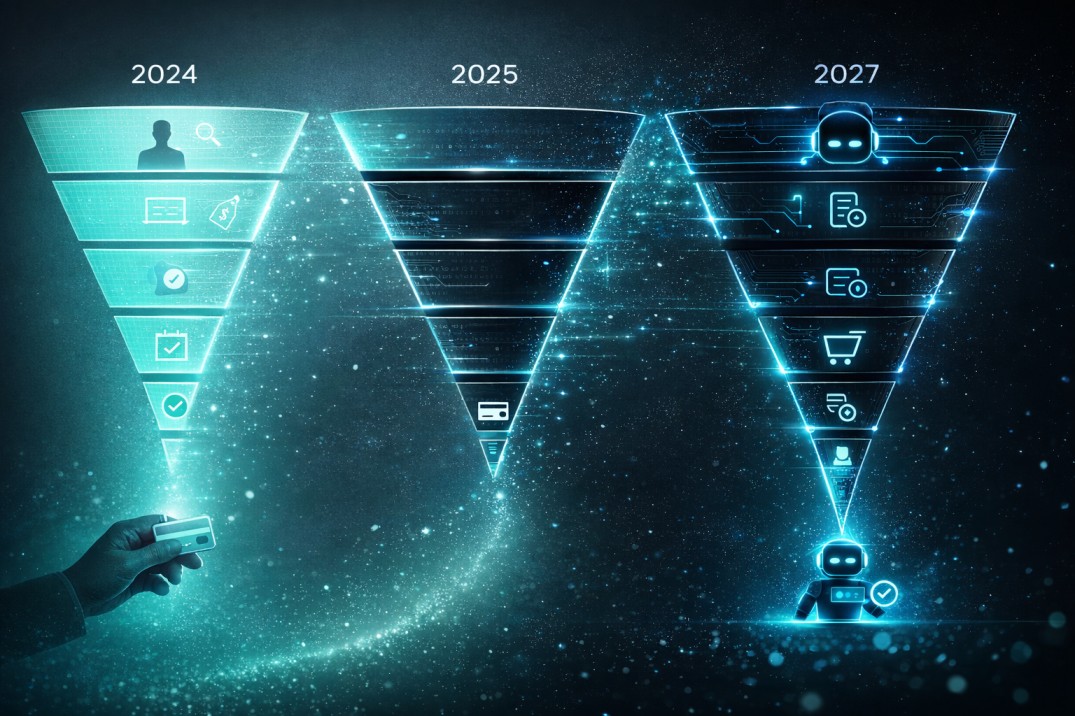
AI agents are reshaping eCommerce SEO, funnels, and conversion. Learn what’s changing, why it matters, and how to prepare your brand for eCommerce in 2026.
eCommerce is entering a structural shift, not a trend, not a temporary disruption, and not just another algorithm update.
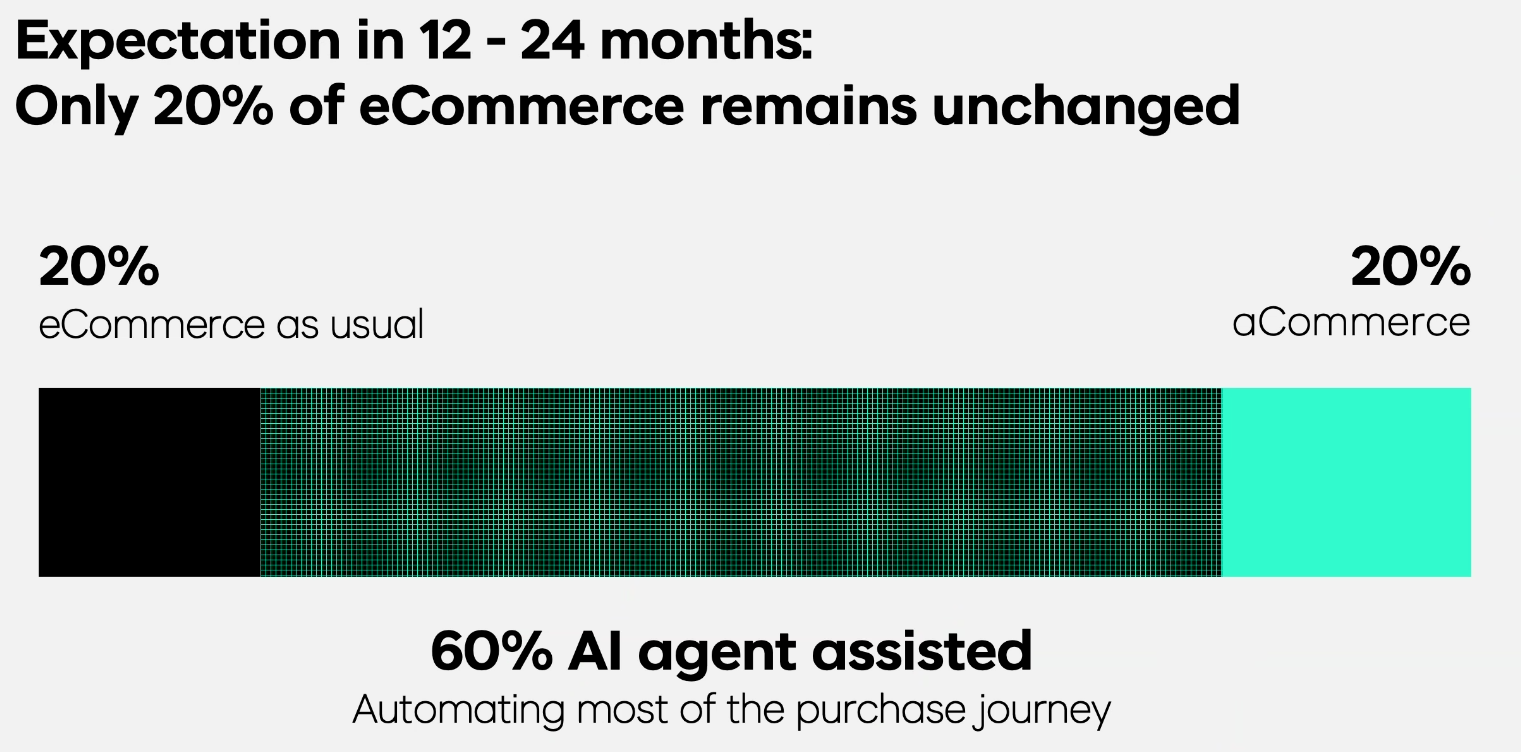
By eCommerce in 2026, the way customers discover, evaluate, and purchase products will look fundamentally different from today. The core reason is simple: AI agents are increasingly acting on behalf of users, handling tasks that were previously manual and human-driven.
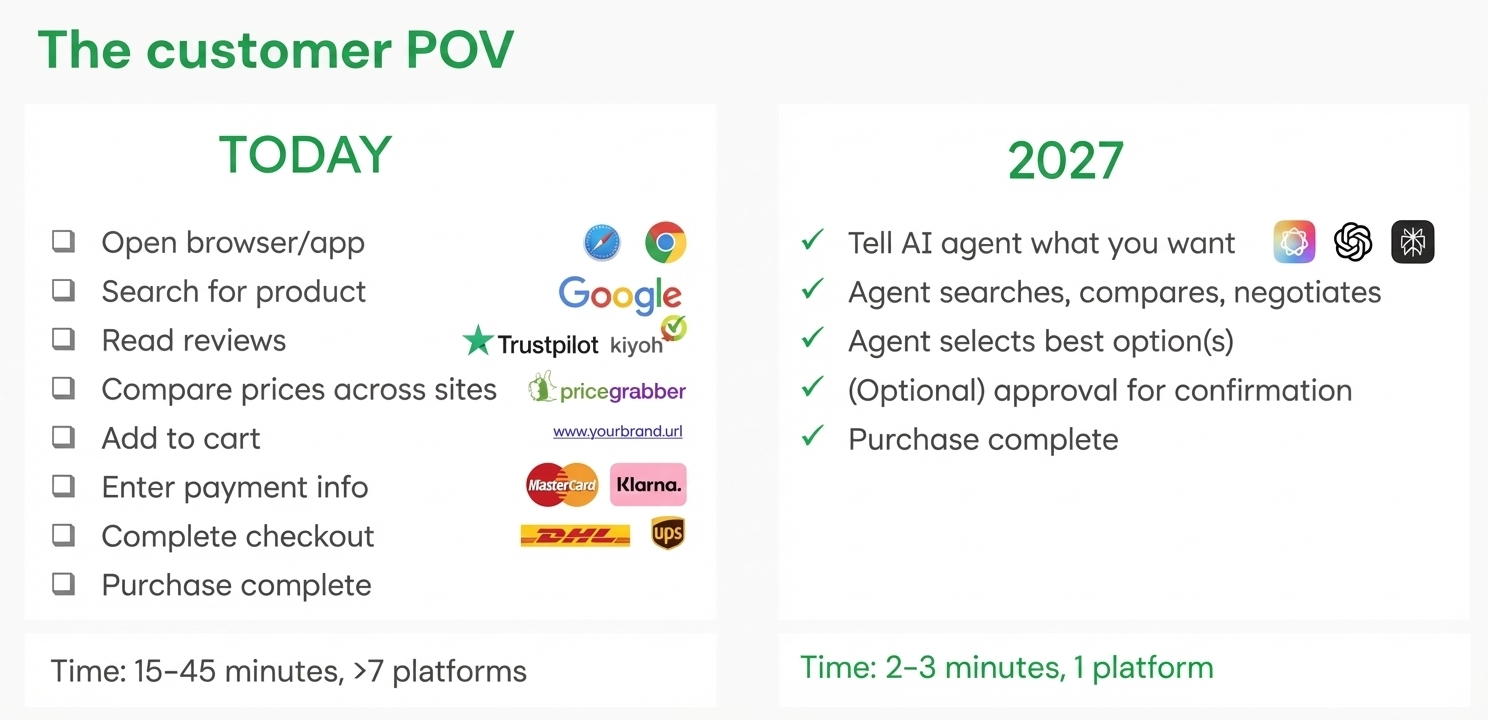
Instead of browsing dozens of product pages, comparing prices across sites, and reading reviews one by one, customers are beginning to delegate these actions to intelligent systems. These systems search, compare, filter, and decide, often before a human ever sees a search results page.
This shift has direct consequences for three foundational pillars of eCommerce growth:
- SEO, where visibility no longer guarantees traffic
- Funnels, which are no longer linear or user-driven
- Conversion, which increasingly happens outside the traditional checkout flow
For eCommerce brands, this means the strategies that worked for the past decade are no longer sufficient. Optimizing for clicks, rankings, and incremental funnel improvements addresses symptoms, not the root change.
The uncomfortable truth is that the traditional eCommerce model was designed for humans, not machines.
And machines are now becoming the primary decision-makers.
This is why conversations around:
- ecommerce SEO future
- ecommerce funnel changing
- how to prepare ecommerce for AI agents
are accelerating rapidly among founders, heads of growth, and digital leaders.
The brands that treat this as a future problem will react too late.
The brands that act now will help define how AI agents evaluate, rank, and select products in the first place.
.png)
The Traditional eCommerce Funnel Is Broken and Why It No Longer Matches Reality
For more than a decade, eCommerce growth strategies were built around a predictable and linear funnel. Users searched for a product, landed on a category or product page, compared options, read reviews, and eventually converted.
This model assumed two fundamental things:
first, that users were willing to invest time and cognitive effort into research, and second, that brands could influence decisions by optimizing each step of that journey.
Both assumptions are increasingly inaccurate.
Today, customer behavior is shaped by automation, recommendation systems, and delegated decision-making. Price comparison tools, browser extensions, marketplace algorithms, and now AI agents are absorbing the work that the traditional funnel was designed to guide. As a result, the traditional eCommerce funnel is broken, not because it fails technically, but because it no longer reflects how decisions are actually made.
From a data perspective, this mismatch is already visible. Brands report higher impressions but lower click-through rates, longer decision cycles despite better UX, and declining marginal returns from funnel optimization efforts. These are not isolated performance issues; they are structural signals that the underlying model is misaligned with reality.
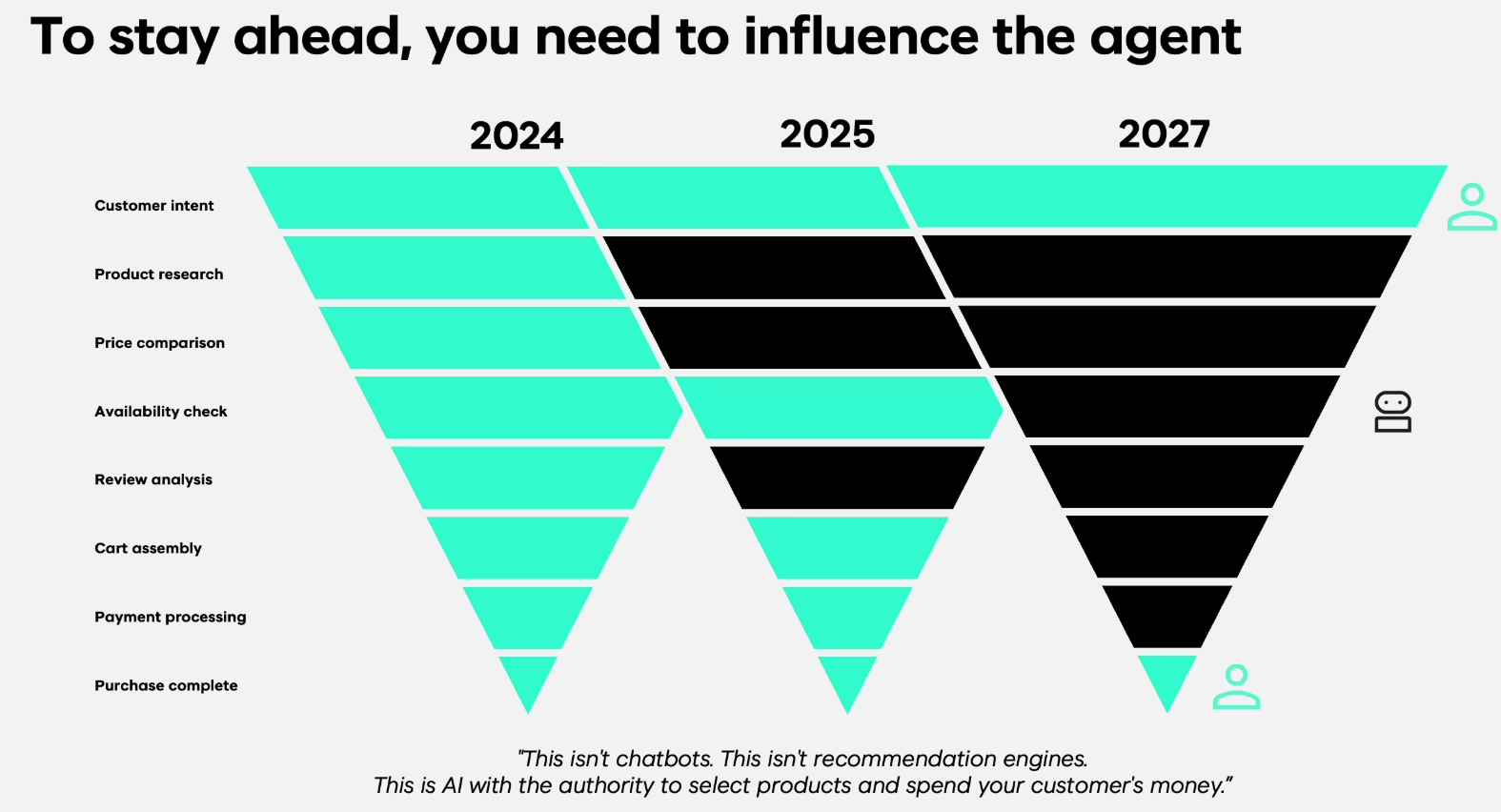
This is where the idea of an ecommerce funnel changing becomes more than a buzzword. The funnel has not disappeared, but it has been fragmented and externalized. Large portions of evaluation now happen outside the brand’s controlled environment, often without direct user interaction.
AI agents accelerate this shift by compressing multiple stages of the funnel into a single automated decision process. Product discovery, comparison, and validation can now happen in seconds, based on structured data, historical signals, and predefined preferences. The result is a funnel that operates largely in the background, invisible to both the user and the brand.
This change has important implications for how eCommerce teams allocate resources. Traditional optimization tactics, improving landing page copy, testing call-to-action buttons, refining on-site flows, still matter, but they address only the final layer of a much larger decision system. When the majority of filtering happens before a user arrives on a website, those optimizations lose leverage.
What replaces the old model is not a new funnel diagram, but a shift in focus. Brands must understand where and how decisions are being made upstream, and how AI-driven systems interpret signals such as relevance, trust, availability, and consistency. Conversion is no longer just the outcome of a well-designed page; it is the result of being selected earlier in an automated evaluation process.
This is why many eCommerce leaders feel that performance improvements have plateaued despite continuous optimization. The problem is not execution quality, but strategic framing. The funnel they are optimizing is no longer the primary decision path.
Understanding this shift is a prerequisite for adapting SEO, content, data infrastructure, and conversion strategy to the realities of eCommerce in 2026. Without this context, tactical improvements risk optimizing for a system that no longer exists.
How AI Agents Are Changing eCommerce SEO (From Rankings to Selection)
For years, eCommerce SEO followed a relatively clear objective: rank higher, get more clicks, and convert traffic on-site. While this model was never perfect, it aligned with how search engines delivered value,by directing users to websites.
That alignment is now breaking.
With the introduction of AI-driven search experiences, including Google AI Overviews, the role of SEO is shifting from traffic acquisition to decision influence. Search engines are no longer just gateways; they are becoming intermediaries that summarize, filter, and recommend, often without requiring a click.
This fundamentally alters the ecommerce SEO future.
Instead of asking “How do we rank?”, brands must now ask:
“How does an AI system understand, trust, and select us?”
AI agents and AI-powered search models do not evaluate websites the same way humans do. They prioritize structure over persuasion, consistency over creativity, and reliability over novelty. Signals such as clear product data, predictable availability, transparent pricing, and verifiable trust indicators carry more weight than traditional on-page optimizations alone.
This explains why many eCommerce brands are experiencing a paradox: strong keyword rankings paired with declining organic traffic. Visibility still exists, but interaction is increasingly absorbed by AI summaries and agent-mediated responses.
In this environment, SEO becomes less about optimizing individual pages and more about shaping how a brand is represented across machine-readable layers. Product feeds, schema markup, knowledge graph consistency, and external validation signals are no longer supporting elements, they are central.
Another critical shift is intent compression. AI agents tend to collapse multiple queries into a single decision flow. Where a user might previously search, compare, and refine across several sessions, an agent can perform these steps instantly. This reduces the number of touchpoints a brand has to influence outcomes and increases the importance of being pre-qualified by the system.
From Google’s perspective, this aligns with recent emphasis on helpful content, real-world usefulness, and experience-based signals. AI systems are trained to reward clarity, depth, and consistency, not surface-level optimization. Thin content, duplicated product descriptions, and purely transactional SEO tactics become liabilities rather than assets.
For eCommerce teams, this means that SEO can no longer operate in isolation. It must connect with data infrastructure, product operations, and brand trust mechanisms. The question is no longer how to optimize for search engines, but how to design a presence that AI systems can reliably act upon.
This shift does not eliminate SEO’s value; it redefines it. Brands that adapt early will influence how agents interpret relevance and authority. Those that don’t will find themselves ranked, but rarely selected.
Is your eCommerce funnel still designed for human-driven buying?
If your SEO performance looks stable but results feel weaker,
the issue may not be rankings,but selection.
We help eCommerce brands understand how AI systems interpret,
filter, and select products in modern search environments.
👉 Request an Agent-Readiness Assessment with ElfShift
Zero-Click Commerce and the New Conversion Model
One of the most underestimated consequences of AI-driven search and autonomous agents is the rise of zero-click commerce.
In this emerging model, discovery, evaluation, and selection increasingly happen without a direct visit to a brand’s website. AI agents retrieve information, compare options, and narrow choices internally, presenting users with a small set of recommendations, or sometimes a single decision.
From the user’s perspective, this feels efficient.
From the brand’s perspective, it introduces a fundamental challenge: conversion is no longer tied to visible interactions.
Traditional conversion models rely on observable signals — page views, add-to-cart events, checkout steps. Zero-click environments remove or abstract many of these signals, making it harder to attribute outcomes to specific touchpoints. Yet conversion still happens. It simply happens earlier, upstream, and often outside the brand’s direct control.
This is where many eCommerce teams misinterpret performance declines. Drops in organic traffic or engagement are often treated as SEO or UX problems, while the real shift is behavioral and systemic. The decision has already been made by the time a user reaches the site — if they reach it at all.
This evolution reinforces why the ecommerce funnel is changing so dramatically. The funnel no longer starts with a click; it starts with data accessibility and machine-level evaluation. Being present at the moment of decision now depends on how well an AI system can assess relevance, trustworthiness, and operational reliability.
For brands still optimizing exclusively for on-site conversion, this creates a blind spot. Improving checkout speed or refining messaging matters less if the brand is filtered out before consideration begins. In zero-click commerce, eligibility precedes conversion.
This is also where the gap between prepared and unprepared brands widens. Companies that invest in structured product data, consistent signals across platforms, and transparent operational logic are easier for AI agents to evaluate. Those that rely on fragmented systems and outdated SEO assumptions become opaque to automated decision-makers.
As we approach eCommerce in 2026, zero-click interactions will not be an edge case. They will be a default pathway for many product categories, particularly those where comparison, availability, and price sensitivity matter. Brands that fail to adapt risk becoming invisible at the most critical stage of the buying process.
Understanding this shift reframes conversion entirely. Success is no longer measured only by how well users convert on-site, but by how often the brand is selected by AI systems in the first place.
And this naturally leads to the most important question decision-makers are now asking: how to prepare ecommerce for AI agents, before zero-click becomes the norm rather than the exception.
How to Prepare eCommerce for AI Agents (In 2026)
As AI agents increasingly influence how products are discovered and explained, the key question for decision-makers is no longer whether this shift is happening, but how to prepare eCommerce for AI agents in a practical and defensible way.
Preparation does not mean adding another tool or experimenting with surface-level automation. It requires a strategic reassessment of how an eCommerce brand exposes information, signals trust, and supports automated decision-making.
At a high level, AI agents evaluate brands very differently from human users. They are less influenced by design and persuasion, and more dependent on clarity, consistency, and reliability. This means that readiness is determined by structural factors rather than cosmetic optimizations.
The first step is understanding how accessible and interpretable your data is. Product information must be complete, consistent across platforms, and structured in a way that machines can easily process. Discrepancies in pricing, availability, specifications, or categorization reduce an agent’s confidence and can exclude a brand before it ever reaches the consideration stage.
The second factor is trust signaling. AI agents rely heavily on external validation signals: reputation, consistency across sources, customer feedback patterns, and operational transparency. Brands that appear fragmented, with conflicting information across marketplaces, feeds, and search results, are harder to evaluate and therefore less likely to be selected.
Another critical dimension is funnel architecture. In an agent-mediated environment, conversion does not begin on the website. It begins when an AI system decides that a brand meets a set of criteria. This requires rethinking funnels as decision systems, not just user journeys. Content, SEO, product data, and operational logic must work together to support that decision.
This is where many organizations struggle. Teams often operate in silos: SEO focuses on rankings, performance teams focus on conversion rate, and product teams focus on usability. AI agents cut across all of these layers simultaneously. Without a unified strategy, optimization efforts become disconnected and inefficient.
As eCommerce in 2026 approaches, readiness will increasingly differentiate brands that maintain demand from those that compete solely on price. Early adopters will shape how agents interpret relevance within their category. Late adopters will adapt to rules defined by others.
For most companies, preparing for this shift requires more than internal adjustments. It requires an external perspective that understands both AI systems and commercial constraints. This is why demand for ecommerce AI consulting is growing, not to replace existing teams, but to help align strategy, data, and execution around an agent-driven future.
Preparation is not a one-time project. It is an ongoing capability that evolves alongside AI systems, search behavior, and platform dynamics. Brands that treat it as a strategic priority now will be better positioned to remain visible, selectable, and competitive as autonomous commerce becomes standard.
Why eCommerce Brands Are Turning to AI Consulting and Specialized Agencies
As AI agents reshape how products are discovered, evaluated, and selected, many eCommerce teams are reaching the same conclusion: adapting to this shift is not a purely tactical challenge.
It is a strategic one.
Most in-house teams are optimized for execution within an existing model — managing SEO performance, improving conversion rates, and scaling paid acquisition. These capabilities remain important, but they are not designed to address a system-level change where decision-making increasingly happens outside the website and outside direct human control.
This gap explains why more brands are actively seeking ecommerce AI consulting rather than additional tools or isolated optimizations.
AI-driven commerce introduces questions that traditional marketing functions are not structured to answer:
- How should product data be exposed so AI agents can reliably interpret it?
- Which trust signals matter most in agent-mediated evaluation?
- How do SEO, content, operations, and conversion systems align when clicks are no longer guaranteed?
- Where does optimization stop being incremental and start being architectural?
Specialized agencies are emerging to address these questions because they sit at the intersection of strategy, data, and execution. Unlike traditional marketing partners, an ecommerce AI agency is not focused solely on traffic or conversion metrics. Its role is to help brands remain selectable in an environment where AI systems increasingly filter choices before users engage.
Another reason brands turn to external expertise is speed. As eCommerce in 2026 approaches, waiting to experiment internally carries opportunity cost. Early movers influence how AI systems learn category relevance, while late movers adapt to standards set by others. Consulting support accelerates this learning curve by providing frameworks, benchmarks, and real-world context across industries.
Importantly, effective AI consulting does not replace internal teams. It complements them by offering a systems-level perspective that aligns SEO, funnel design, data infrastructure, and automation under a single strategic lens. This alignment is difficult to achieve when responsibilities are fragmented across departments.
For decision-makers, the value lies in clarity. Rather than reacting to declining performance indicators or chasing emerging tools, brands gain a structured understanding of where they stand, what needs to change, and how to prioritize investments. This clarity is often the difference between incremental optimization and meaningful transformation.
As autonomous commerce continues to mature, the role of specialized partners will become less about experimentation and more about governance — ensuring that brands operate effectively within AI-mediated ecosystems without losing control over positioning, margins, or customer relationships.
This shift marks a broader evolution in how growth support is defined. Agencies are no longer judged only by execution capacity, but by their ability to guide brands through structural change.
Which eCommerce Categories Will Be Disrupted First by AI Agents
Not all eCommerce categories will be affected by AI agents at the same speed or intensity. One of the most common mistakes brands make is assuming that agent-driven commerce will arrive uniformly across all industries.
In reality, disruption follows clear structural patterns.
The chart above illustrates how industries differ based on two key dimensions: commoditization risk and current suitability for agent-mediated commerce. Together, these dimensions determine how quickly AI agents can replace or compress traditional buying journeys.
Categories positioned in the top-right quadrant, such as consumer electronics, pharmacies, basic travel, insurance, and utilities, are likely to experience the earliest and most aggressive disruption. These markets share common characteristics: standardized products or services, transparent specifications, price sensitivity, and high comparability. For AI agents, these environments are ideal. Decision logic can be automated, trade-offs can be evaluated quickly, and outcomes can be optimized with minimal human intervention.
In contrast, categories driven by routine purchasing and light brand preference, including groceries, home basics, personal care, and fashion essentials, represent the next wave. While emotional differentiation still exists, much of the decision-making can be systematized over time, especially as agents learn recurring preferences and consumption patterns.
Finally, categories rooted in high personal value, experience, or uniqueness, such as luxury goods, interior design, leisure, and premium fashion — are likely to be disrupted later. In these cases, emotional context, identity, and subjective evaluation slow down full automation. However, even here, AI agents will increasingly influence discovery, filtering, and shortlisting.
For eCommerce leaders, the takeaway is not whether disruption will happen, but where their category sits on this spectrum. Brands operating in high-suitability segments face immediate pressure to adapt, while others still have a window, albeit a shrinking one, to prepare strategically.
This perspective is especially important when thinking about eCommerce in 2026. AI agents will not wait for universal readiness. They will reshape categories where automation delivers the highest efficiency gains first, forcing brands in those spaces to respond faster than anticipated.
Understanding category-level exposure is a critical step in defining priorities, investment timelines, and strategic urgency. It also explains why preparation efforts must be tailored, not every eCommerce brand needs the same roadmap, but every brand needs clarity on its position.

How ElfShift Helps eCommerce Brands Navigate the Shift to Agentic Commerce
As AI agents increasingly shape how products are discovered, evaluated, and selected, eCommerce brands face a new type of challenge. The issue is no longer limited to traffic acquisition or conversion rate optimization, but to maintaining relevance within automated decision systems.
ElfShift was built specifically to address this shift.
Rather than operating as a traditional marketing partner, ElfShift works with brands at the intersection of strategy, data, and execution — helping them adapt to an environment where SEO, funnels, and conversion are influenced by AI agents rather than linear user journeys.
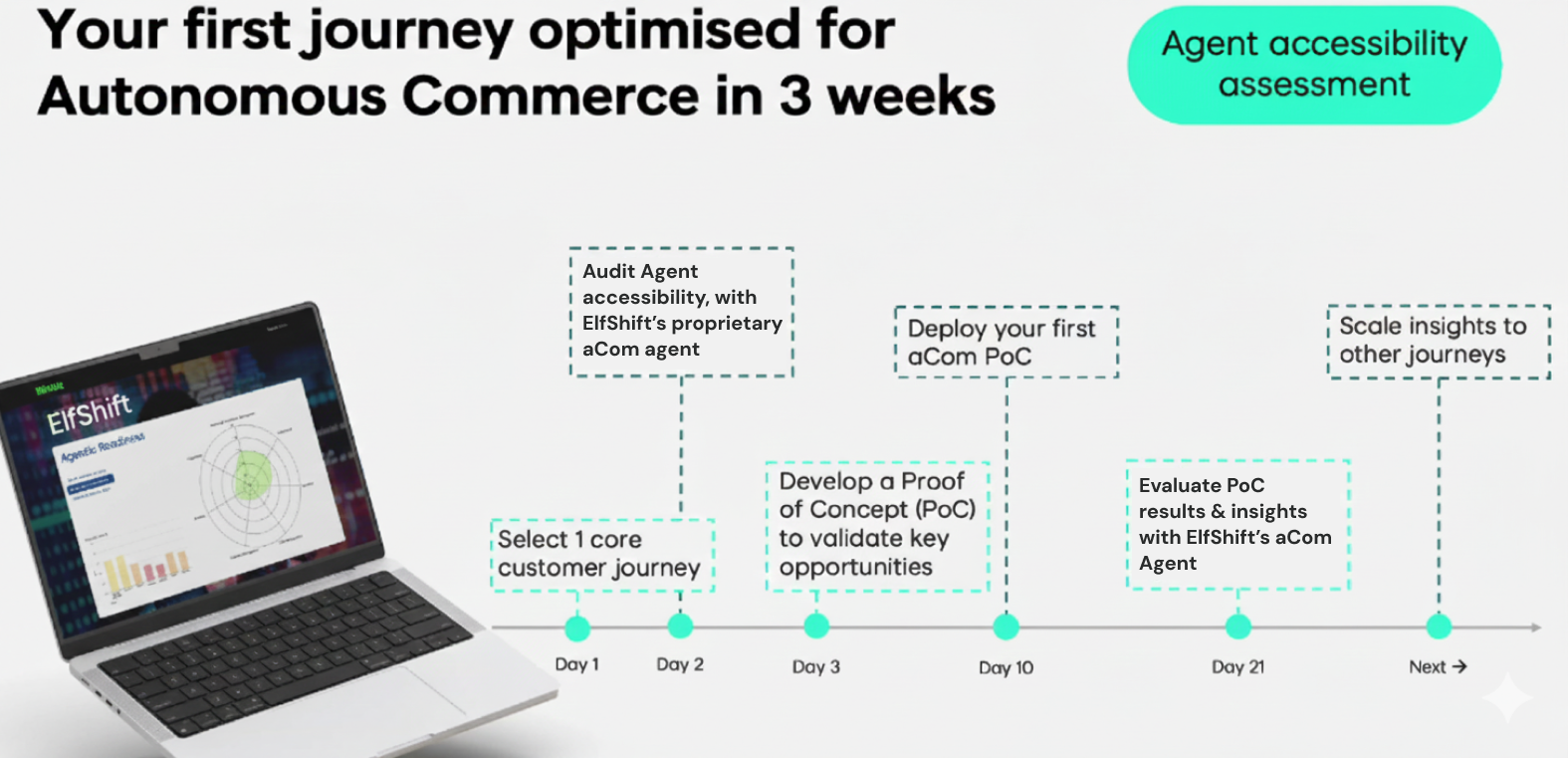
Our approach starts with understanding how a brand is currently perceived by machine-driven systems. This includes evaluating product data structure, consistency across platforms, trust signals, and how effectively information can be interpreted by AI-powered search and agent frameworks. The goal is not surface-level optimization, but identifying structural gaps that limit visibility and selection in agent-mediated commerce.
From there, we help brands redesign their growth architecture with the future in mind. This often involves aligning SEO strategy with AI-readable content, rethinking funnel logic to support decision-making upstream, and building systems that support automated evaluation without sacrificing commercial control.
As an ecommerce AI agency, ElfShift does not offer one-size-fits-all solutions. Each engagement is shaped around the brand’s category, maturity, and operational constraints. Some teams need clarity on readiness and prioritization. Others need hands-on execution to modernize their data and funnel infrastructure. In both cases, the focus remains the same: preparing brands for how commerce actually works today — and how it will work in eCommerce in 2026.
What differentiates this work from traditional optimization is intent. Instead of chasing incremental gains within a fading model, the objective is to help brands remain selectable, trustworthy, and competitive as autonomous systems take on a larger role in buying decisions.
For decision-makers, this often begins with a simple but critical step: understanding where they stand. Knowing whether current systems support or hinder AI-driven evaluation provides clarity that tactical performance metrics alone can no longer offer.
Final Thought: Preparing for What’s Already Happening
AI agents are no longer a theoretical concept. They are already changing how SEO performs, how funnels function, and how conversion occurs — often outside direct visibility.
Brands that acknowledge this shift early gain the opportunity to adapt deliberately. Those that ignore it risk optimizing for a version of eCommerce that is rapidly disappearing.
Is your eCommerce brand prepared for AI-driven buying decisions?
Get a clear, strategic view of your readiness, and what needs to change before 2026.
👉 Request an Agent-Readiness Assessment with ElfShift


